Article
The Politics behind the Ebola Crisis
Duncan McLean
28.10.2015West Africa is still paying the price for its poor response to the Ebola epidemic. Where an early response could have prevented the worst, failures on all levels allowed Ebola to spread, exposing a...
Article
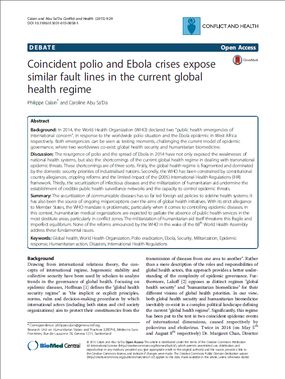
Coincident polio and Ebola crises expose similar fault lines in the current global health regime
Caroline Abu-Sada, Philippe Calain
2015In 2014, the World Health Organization (WHO) declared two "public health emergencies of international concern", in response to the worldwide polio situation and the Ebola epidemic in West Africa...
Article
Counterterrorism policies and practices: health and values at stake
Philippe Calain
2015The United States Central Intelligence Agency (CIA) used a fake vaccination programme to obtain DNA samples in the search for Osama Bin Laden, which caused distrust and hampered polio eradication and ...
Article
Care for victims of sexual violence, an organization pushed to its limits: The case of Médecins Sans Frontières
Françoise Duroch
01.09.2015Over the past ten years, Médecins Sans Frontières (MSF) has provided medical care to almost 118,000 victims of sexual violence. Integrating related care into MSF general assistance to populations...
Article
Reconstruction of the health sector in Haiti: a missed opportunity?
Maude Montani
2015The impact of the 2010 earthquake in Haiti was devastating for a country whose history was already marked by poverty, natural disasters, environmental degradation and political instability. An...
Article
Ebola healthcare workers: a hazardous and isolating job
Marc Poncin
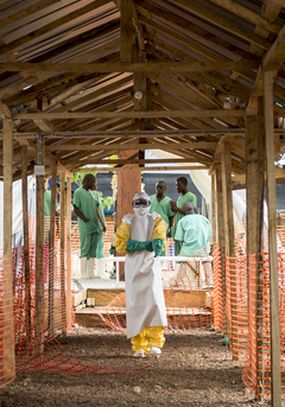
2015As of the 31st of March 2015, 418 out of 815 infected health care workers had died from the Ebola virus in Guinea, Liberia and Sierra Leone, according to a recent WHO report. 217 recovered and the...
Article
Extractive resources and the Ebola economy
Philippe Calain
2015Letter about extractive resources and Ebola, a response to the recent briefing by Wilkinson and Leach “Briefing: Ebola–myths, realities, and structural violence” published in African Affairs.
Article
Gold, Fire and Gallows: Quarantine in History
Duncan McLean
01.12.2014As the Ebola outbreak in West Africa continues its dreadful march, Duncan McLean looks at the 600-year-old practice of isolating individuals and communities in order to bring an end to epidemics and...
Article
Ebola outbreak in Conakry, Guinea: epidemiological, clinical, and outcome features
Marc Poncin
01.12.2014The authors studied the epidemiological, clinical, and outcome features of the Ebola virus disease in patients hospitalized at the Ebola treatment center (ETC) in Conakry to identify clinical factors ...
Article
Working in a prison in Myanmar: Médecins Sans Frontières’ experience working in Insein prison
Jean-Marc Biquet
2014Working in a prison for a humanitarian organisation is not easy, particularly because of the specific characteristics of such places. Médecins Sans Frontières’ experience working in Insein...

Article
Advocating “Dignity” and “Return” for Lebanon’s Palestinians: Imagining a Diasporic Project
Sergio Bianchi
2014The 2010 reform of the legal regime regulating Palestinians’ access to the labour market in Lebanon ignited a heated debate among Lebanese, Palestinians, and international political actors....
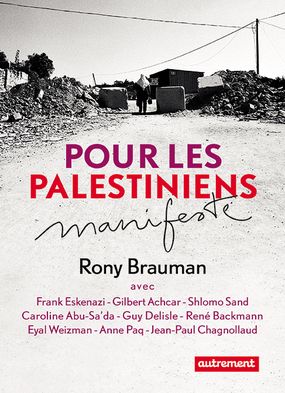
Book
L’urgence d’une souveraineté alimentaire
Caroline Abu-Sada
2014From France, Rony Brauman, former president of MSF France, gives us his reading of the philosophical, political and symbolic stakes of Palestine and of this debate – one that particularly...